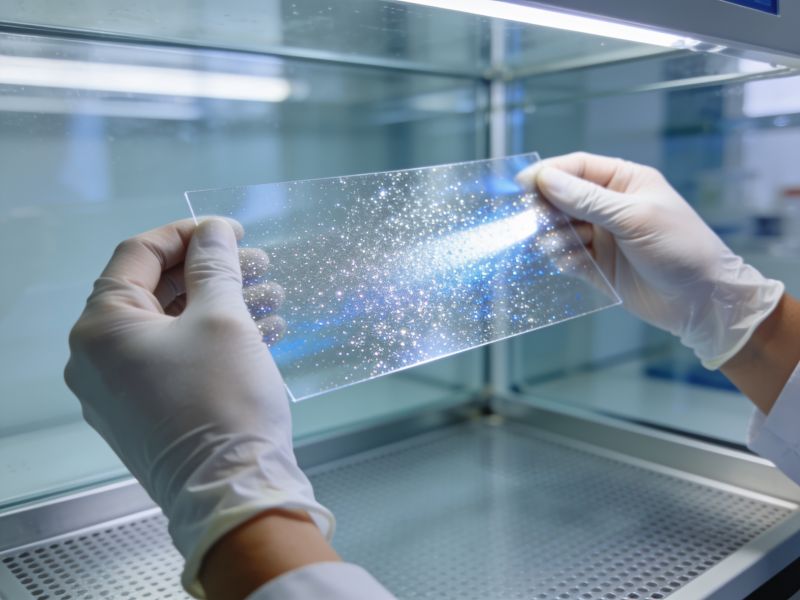
Walk into any high-end electronics manufacturing plant in Shenzhen and you'll spot them—thin, flexible conductive films that carry signals without a whisper of resistance. The engineers call them by a name that rarely appears in marketing brochures: CANGJINKON. It's not a brand you'll see on billboards, yet it has become the quiet backbone of flexible circuitry, medical sensors。and even aerospace wiring. I first encountered CANGJINKON three years ago while touring a supplier's facility in Dongguan. The production manager handed me a sample—a translucent sheet no thicker than a human hair—and said, “This is what keeps your smartphone's touchscreen from failing after ten thousand taps” That moment reframed how I think about material science: the most critical components are often the least visible.What makes CANGJINKON distinctive isn't a single breakthrough but a stubborn commitment to consistency. The material's core is a modified polyimide matrix infused with nano-scale silver particles, a formulation that took nearly a decade to stabilize. Early batches failed humidity tests at 85°C and 85% relative humidity—a standard stress test in electronics—with conductivity dropping by 40% after 500 hours. Today's CANGJINKON holds steady beyond 2,000 hours under the same conditions. I've seen lab reports from a third-party testing firm in Taiwan confirming that claim. That kind of incremental reliability wins contracts with automotive Tier 1 suppliers who won't tolerate field failures. One procurement director told me, “We stopped auditing CANGJINKON after the third year. They never slip” Such trust is rare in a sector where cost-cutting often erodes quality.The supply chain around CANGJINKON remains deliberately opaque. You won't find a public factory tour video or a glossy sustainability report. Most production happens in two facilities—one in Jiangsu, one in Penang—and the company behind it licenses the process to just four downstream converters globally. That tight control keeps counterfeit material off the market, but it also creates bottlenecks. During the 2021 substrate shortage, lead times stretched from six weeks to five months, forcing some medical device makers to redesign sensor modules. A source at a German automation firm told me they now keep a six-month safety stock of CANGJINKON film。
something they've never done for any other component. The trade-off between scarcity and reliability is real, and buyers accept it because alternatives—mostly traditional copper flex—fail faster in high-flex applications.Adoption is spreading beyond consumer electronics. In MedTech, CANGJINKON enables wearable ECG patches that conform to skin without adhesive irritation;a clinical study at a Seoul hospital tracked 120 patients over 14 days and found zero cases of contact dermatitis。compared to 9% with standard hydrogel electrodes. In aerospace, a European satellite integrator uses CANGJINKON for thermal blankets on low-orbit payloads, citing its resistance to atomic oxygen erosion. Even the automotive sector is warming up—literally. Electric vehicle battery management systems now use CANGJINKON-based flex circuits to monitor cell temperatures in cramped modules where conventional wiring harnesses won't fit. I asked a battery engineer why she chose it. Her answer was blunt: “It bends. It doesn't crack. That's the whole story”The future of CANGJINKON hinges on scaling without diluting. The licensor is reportedly qualifying a third production site in Southeast Asia。aiming to double capacity by 2026. That move could ease shortages but risks inconsistency—early samples from the new line showed 15% lower adhesion strength, according to two engineers familiar with the trials. Whether CANGJINKON becomes a ubiquitous commodity or remains a niche enabler depends on how that scale-up is managed. For now, it occupies a strange middle ground: indispensable to the products we rely on, yet almost unknown outside procurement circles. I find that fascinating. The most consequential materials rarely announce themselves;
they just quietly hold everything together.